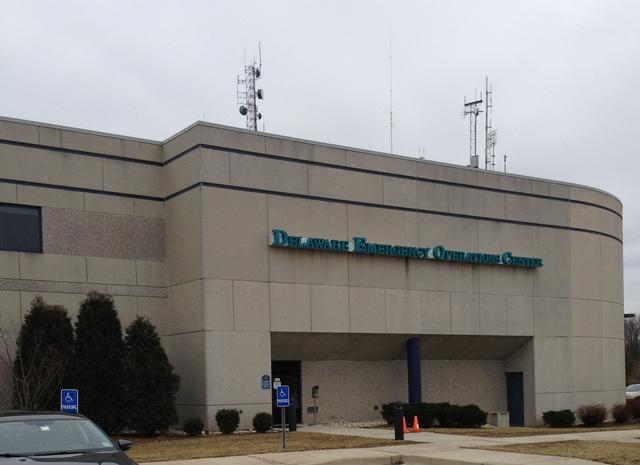
| This past week, 2 members of the East Whiteland Fire Company spent time in Dover, Delaware at the Delaware Emergency Operations Center learning about incident command and management of large-scale/catastrophic incidents. Members Michael Schon and John Temple spent the week learning from and training with members of the Delaware Emergency Management Agency (DEMA) and other State and Federal agencies to become incident commanders for a "Type III" Incident Management Team.
In the United States, there are predominantly five types of incident management teams (IMTs). An incident is typically initially managed by local fire departments, but if the situation becomes complex, additional resources are called in to address the emergency, and higher levels of management training and capability are required. IMTs are "typed" according to the complexity of incidents they are capable of managing, and are part of an incident command system.
To manage the operational, logistical, fiscal, planning, safety and community issues related to the incident/emergency, an Incident Management Team will provide the command and control infrastructure that is required.
Incident management starts as the smallest unit and escalates according to the complexity of the emergency. The five types of IMTs are as follows:
-Type 5: Local Village and Township Level – a "pool" of primarily fire officers from several neighboring departments that are trained to serve in Command and General Staff positions during the first 6–12 hours of a major or complex incident.
-Type 4: City, County or Fire District Level – a designated team of fire, EMS, and possibly law enforcement officers from a larger and generally more populated area, typically within a single jurisdiction (city or county), activated when necessary to manage a major or complex incident during the first 6–12 hours and possibly transition to a Type 3 IMT.
-Type 3: State or Metropolitan Area Level – a standing team of trained personnel from different departments, organizations, agencies, and jurisdictions within a state or DHS Urban Area Security Initiative (UASI) region, activated to support incident management at incidents that extend beyond one operational period. Type 3 IMTs will respond throughout the State or large portions of the State, depending upon State-specific laws, policies, and regulations.
-Type 2: National and State Level – a Federally or State-certified team; has less training, staffing and experience than Type 1 IMTs, and is typically used on smaller scale national or state incidents. There are 35 Type 2 IMTs currently in existence, and operate through interagency cooperation of federal, state and local land and emergency management agencies.
-Type 1: National and State Level – a Federally or State-certified team; is the most robust IMT with the most training and experience. Sixteen Type 1 IMTs are now in existence, and operate through interagency cooperation of federal, state and local land and emergency management agencies
Incident Management Teams can respond to a wide range of emergencies, including fires, floods, earthquakes, hurricanes, tornadoes, tsunami, riots, hazardous materials incidents, terrorist attacks, and other natural or human-caused incidents.
Congratulations to Michael and John for achieving this advanced level of certification! |