|
|
National Arson Awareness Week: Prevent Youth Firesetting |
| By News Desk | |
| May 9, 2012 | |
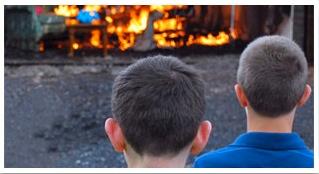
| The United States Fire Administration (USFA) theme for this year's National Arson Awareness Week, May 6-12, 2012, is "Prevent Youth Firesetting." Youth firesetting is often referred to as the preventable arson. Each year in this country, fires set by children are responsible for more than 100 fire deaths, nearly 1,000 painful burn injuries, and hundreds of millions of dollars in property loss, according to the U.S. Fire Administration. Children are often the victims in these fires. While curiosity about fire is natural, fires set by children are dangerous and deadly. Why Do Kids Set Fires? The best way to understand why children set fires is to look at their motivations for firesetting. For most young kids, the motive is experimentation and curiosity. Motives can involve curiosity, a cry for help, thrill-seeking, willful intent to cause destruction, or by children who suffer from mental or emotional problems. Remember, if you suspect your child is setting fires, you are not the only parent ever to face this problem. Contact your local fire department immediately. Explain the situation to them. Many fire departments offer youth firesetting prevention and intervention programs. Parents, caregivers, and public educators, whether they are from the fire department or the school system, can build an informed foundation by teaching fire safety at an early age. Teach children of all ages that fires, even small ones, can spread quickly. Teaching Children Fire Safety The most critical message for children to learn is that matches and lighters are tools, not toys! Parents should never use lighters, matches, and fire for fun; children will mimic you, and when they do it unsupervised, tragic events can result. Praise your child for practicing responsible behavior and showing respect for fire. Set a good example: use matches, lighters, and fire carefully, as children will imitate positive behavior too. • Always supervise young children.
Youth Firesetting Facts According to the National Fire Protection Association (NFPA): • Fires started by children playing accounted for an average of 56,300 fires with associated losses of 110 civilian deaths, 880 civilian injuries, and $286 million in direct property damage per year between 2005 and 2009.
The U.S. Fire Administration's National Fire Incident Reporting System (NFIRS) data indicate, where age was cited as a factor in a fire's ignition by lighters or matches, 37 percent of these fires were started by juveniles aged 10 to 17. According to the Federal Bureau of Investigation's (FBI's) Uniform Crime Reporting (UCR) Program: • Juveniles (persons under age 18) accounted for roughly 46 percent of arson arrests in 2005 to 2010.
The Bureau of Alcohol, Tobacco, Fire and Explosives (ATF) reports that from 2000 to 2009: • There were 1,637 juvenile-involved fire incidents reported in Bomb Arson Tracking System (BATS).
|
|
|
|